BOOK Prolis LIS DEMO

LIS | Laboratory Information System
A complete guide to Laboratory Information System (LIS) from how an it works, core capabilities to LIS vs LIMS differences and how to choose the right platform for your lab.
70%
of clinical decisions influenced by laboratory data
40%
reduction in transcription errors after LIS implementation
What is a LIS?
A Laboratory Information System is purpose-built healthcare software that manages the complete clinical laboratory workflow from electronic test ordering and barcode specimen tracking to analyzer integration, automated quality control, result reporting, and billing. A modern LIS system coordinates every touchpoint in the laboratory lifecycle while ensuring CLIA compliance, eliminating transcription errors, and enabling faster, more accurate clinical decisions.
At its core, a Laboratory Information System serves as the central nervous system of a modern clinical laboratory. It connects test ordering, sample tracking, analyzer interfaces, result reporting, and billing into a single, unified digital environment eliminating the data silos and manual handoffs that slow laboratories down and introduce errors.
Unlike general hospital information systems, an LIS is purpose-built for the unique regulatory, analytical, and patient safety requirements of the laboratory. It tracks, stores, and continuously updates clinical details about a patient across every visit, preserving that data for longitudinal reference and empowering smarter clinical decisions. When evaluating LIS, look for platforms that cover all six stages of the lab lifecycle described below.
Watch: Laboratory Information System Explained
A concise visual breakdown of how LIS software operates inside a modern clinical laboratory.
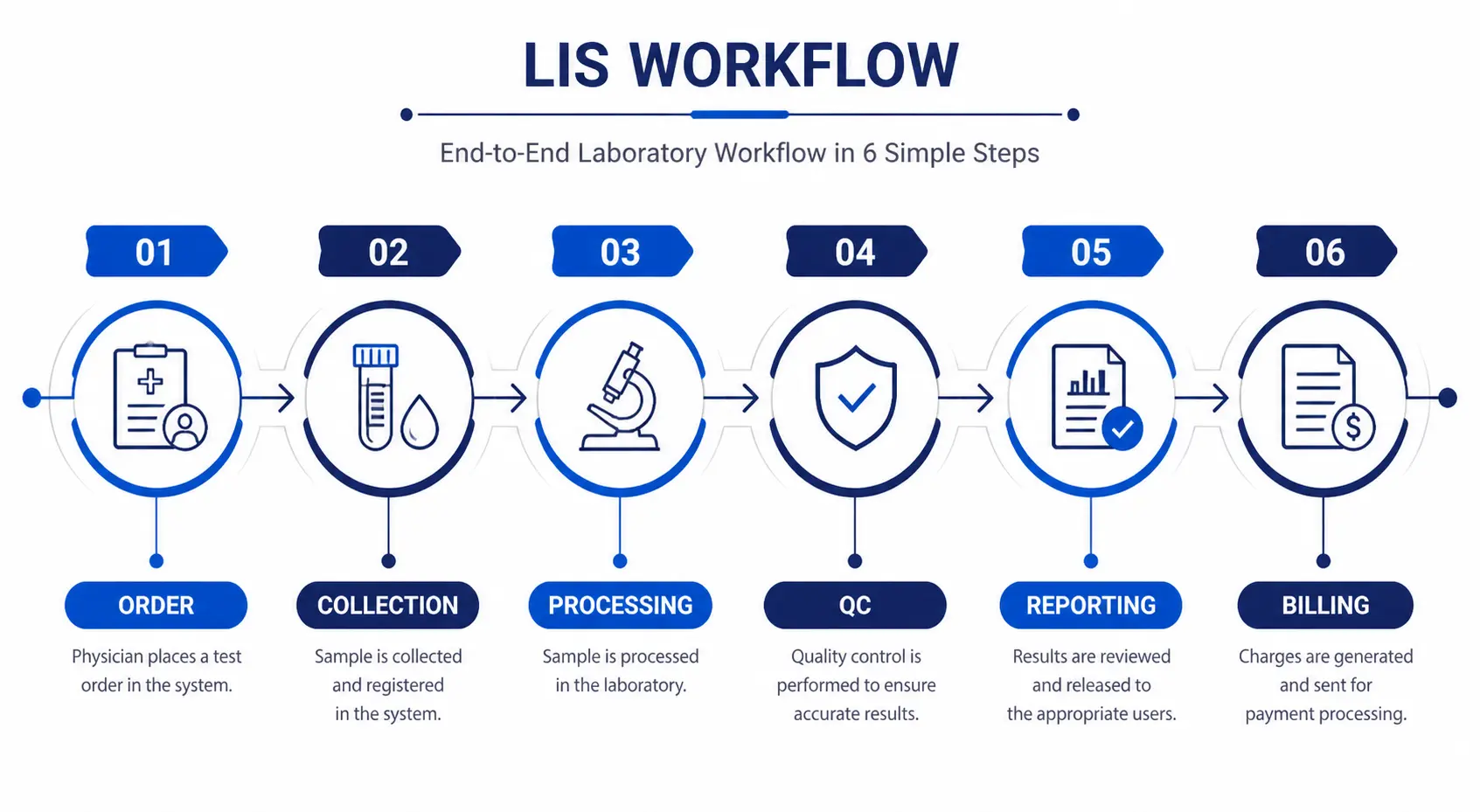
How does a LIS software work? A 6-Step Breakdown
From the moment a test is ordered to the delivery of actionable results, the LIS orchestrates every touchpoint in the clinical laboratory lifecycle. Here is what happens at each stage.
-
Test Order Intake & Patient Registration
The LIS receives test orders electronically from clinicians, physicians, or connected hospital information systems (HIS). Patient demographic and insurance data is captured and validated against existing records eliminating duplicates and reducing registration errors before any specimen is collected.
-
Specimen Collection & Chain-of-Custody Tracking
Labels with barcodes or QR identifiers are auto-generated the moment an order is placed. Throughout collection and transport, the LIS maintains an unbroken chain of custody recording who collected the sample, when, and where ensuring regulatory compliance and eliminating sample misidentification risk.
-
Analyzer Integration & Automated Processing
The LIS system interfaces bidirectionally with laboratory analyzers across hematology, chemistry, immunology, microbiology, toxicology, and other disciplines. Orders are automatically routed to the correct analyzer; results are received and processed in real time, eliminating manual data entry and dramatically accelerating turnaround times.
-
Quality Control, Rules Engine & Validation
Built-in decision-support rules based on Westgard principles and CLIA quality standards evaluate each result against configurable reference ranges, delta checks, and critical value thresholds. Anomalous results are automatically flagged for technologist review ensuring every reported value meets clinical quality standards before it reaches the ordering provider.
-
Automated Result Reporting & EHR/HIS Transmission
Validated results are transmitted automatically to the Electronic Health Record (EHR), HIS, practice management platform, or patient portal. Critical values trigger real-time alerts to ordering providers dramatically reducing the time between test completion and clinical action. This seamless integration is a core differentiator of a modern Laboratory Information System versus manual workflows.
-
Billing, Compliance & Audit Trail
The LIS automatically generates charge capture data tied to every performed test, reducing billing lag and improving reimbursement rates. A comprehensive, timestamped audit trail satisfies CAP, CLIA, HIPAA, and other regulatory requirements providing evidence-ready documentation for inspections and accreditation reviews.
LIS vs.LIMS: Key differences between laboratory information and management systems
LIS and LIMS are terms used interchangeably but were designed for fundamentally different environments. Here is how they compare side by side.
| Dimension | LIS Laboratory Information System | LIMS Lab Information Management System |
|---|---|---|
| Primary Focus | Patient-centric workflows; personal, demographic, and clinical health data associated with diagnostic testing | Sample-centric workflows; tracking samples, batches, and quality data independent of a specific patient identity |
| Typical Setting | Clinical and anatomic pathology laboratories, hospitals, physician offices, urgent care, reference labs | Research labs, environmental labs, food & beverage testing, pharmaceutical, and industrial quality labs |
| Core Data Model | Patient → Encounter → Order → Result → Report; longitudinal patient record maintained | Sample → Test → Result; data organized by sample batch or project rather than patient record |
| Regulatory Compliance | CLIA, CAP, HIPAA, HL7, IHE, FDA 21 CFR Part 11 (clinical focus) | ISO 17025, GLP, GMP, FDA 21 CFR Part 11 (research/industrial focus) |
| EHR / HIS Integration | Deep, bidirectional HL7/FHIR integration with EHR and HIS is a core requirement of any LIS system | EHR integration is secondary; typically integrates with adjacent platforms or ERPs |
| Critical Value Alerting | Essential real-time alerts to ordering providers for patient safety | Not typically required; focus is on out-of-specification flagging for quality control |
| Billing & Reimbursement | Integrated charge capture and CPT coding tied to ordered tests | Generally not applicable; costs tracked through project or contract management |
| Today's Reality | Modern platforms increasingly blur the boundary — offering configurable features that serve both patient-centric (LIS) and sample-centric (LIMS) workflows within a single unified system. | |
Bottom line: If your laboratory's primary mission involves diagnosing and treating patients, you need a dedicated LIS. If your work is primarily research, environmental, or industrial testing, a LIMS is the better fit. Many modern LIS software platforms now support both contact us to find the right match for your laboratory.
Core benefits of a modern LIS system
A powerful Laboratory Information System is not just a data repository it is a strategic clinical asset that directly impacts patient safety, laboratory efficiency, and organizational profitability.
Benefit 01
Meet Quality Control Standards Consistently
Modern LIS software embeds Westgard rules, delta checking, and inter-laboratory comparison protocols directly into the result workflow. Every data point is automatically evaluated before reaching the reporting stage ensuring your lab meets CAP, CLIA, and accreditation body requirements without manual intervention, and producing an audit-ready quality record at all times.
Benefit 02
Dramatically Decrease Transcription Errors
Manual transcription between systems is one of the leading sources of laboratory error. A dedicated LIS eliminates the need to re-enter data at every handoff from order entry to analyzer interface to EHR creating a fully automated, error-resistant information chain that protects patients and reduces liability.
Benefit 03
Streamline & Accelerate Laboratory Workflows
Configurable workflow automation allows your LIS software to route orders intelligently, prioritize STAT specimens, manage reflexive testing protocols, and alert staff to bottlenecks in real time. The result: higher volumes processed with the same or fewer staff without sacrificing accuracy or compliance.
Benefit 04
Elevate Patient Care & Clinical Outcomes
When test results are accurate, faster, and paired with intelligent clinical decision support, providers diagnose sooner and treat more effectively. A patient-centric Laboratory Information System bridges the gap between the lab and the bedside empowering clinicians with the right data at the right moment to improve outcomes across hematology, microbiology, chemistry, immunology, and beyond.
Key capabilities of a leading LIS
The best LIS deliver a comprehensive suite of integrated capabilities designed to serve every operational and clinical need of the modern laboratory.
Automated Order & Result Management
Receive, route, and process test orders from any connected system. Deliver validated results to EHR, HIS, and patient portals automatically with zero manual steps.
Specimen Tracking & Chain of Custody
Barcode-driven tracking monitors every specimen from collection to disposal ensuring regulatory compliance and eliminating sample misidentification across all LIS.
Analyzer Instrument Integration
Bidirectional interfaces with hundreds of analyzer models across all disciplines enable real-time data transfer, eliminating manual transcription entirely from your LIS workflow.
Quality Control & Validation Rules
Configurable Westgard rules, delta checks, and reference range logic automatically validate every result before reporting ensuring clinical accuracy at scale.
Advanced Analytics & Data Mining
Built-in dashboards, trend analysis, and population health analytics transform raw lab data into actionable clinical and operational intelligence for laboratory leadership.
Interoperability & HL7/FHIR Compliance
Seamless exchange with EHR, HIS, billing, HIE, and reference laboratory systems via HL7 v2, FHIR R4, and proprietary interfaces a non-negotiable for any modern LIS integration.
Compliance & Regulatory Reporting
Automated generation of CLIA, CAP, and public health reporting data with fully timestamped audit trails keeps your laboratory inspection-ready at all times.
Real-Time Critical Value Alerting
Instant, configurable alerts notify ordering providers the moment a critical value is verified closing the loop between laboratory findings and bedside clinical action.
Patient-Centric Outreach & Portal Access
Enable direct-to-patient result delivery, appointment scheduling, and longitudinal test history access through integrated patient portal functionality.
Why do laboratories need a dedicated laboratory systems?
In today's regulatory and data-intensive healthcare environment, a generic software solution cannot meet the complexity demands of clinical laboratory operations. Here is why a purpose-built LIS is non-negotiable.
Support Laboratory Workflow Efficiency
Modern healthcare laboratories process thousands of specimens daily across dozens of test types. A dedicated LIS solution manages order intake, specimen tracking, and analyzer integration see our complete guide to LIS workflow automation to learn how modern platforms optimize each step.
Ensure Consistent Procedure Execution
Variability in laboratory procedure is a direct patient safety risk. A robust LIS enforces standardized protocols across all staff and shifts increasing productivity, reducing human error, and supporting the timely, accurate clinical decision-making that providers depend on.
Automate Billing & Maximize Reimbursement
Complex laboratory billing demands precision. A fully integrated LIS captures charge data at test completion, auto-populates CPT codes, checks for missing information, and submits clean claims dramatically reducing denials, accelerating revenue cycles, and freeing billing staff from repetitive manual tasks.
Who uses a laboratory information system?
LIS software serve a broad spectrum of clinical and diagnostic environments where patient-centric laboratory data must be managed with precision, speed, and regulatory compliance.
Hospital Laboratories
Core & reference lab consolidation with 24/7 critical value alerting and deep EHR integration
Physician Office Labs
Point-of-care result management and streamlined billing in ambulatory settings
Independent Reference Labs
High-volume, multi-site specimen tracking with client portal result delivery
Anatomic Pathology Labs
Tissue specimen management, case workflow, and pathologist sign-out support
Microbiology & Virology
Culture workflow management, antibiogram reporting, and infection control analytics
Public Health Laboratories
Communicable disease surveillance, outbreak analytics, and mandatory state reporting
Toxicology Clinics
Chain-of-custody tracking, drug screening workflow, and MRO result management
Academic & Teaching Hospitals
Research-integrated clinical data capture supporting dual clinical and discovery missions
LIS selection checklist: How to evaluate vendors
Choosing the right LIS software is one of the most consequential decisions your laboratory will make. Use this checklist when evaluating Laboratory Information System vendors:
Core LIS functionality
Must-Have Features
Deployment & Architecture
Integration & Interoperability
Support & Implementation
Cost Transparency
FAQs about LIS
What is a LIS system?
An LIS is purpose-built healthcare software that manages the complete clinical laboratory workflow from electronic test ordering and barcode specimen tracking to analyzer integration, quality control, automated result reporting, and billing. It serves as the operational core of any modern clinical laboratory, eliminating manual handoffs and ensuring regulatory compliance at every stage of the testing process.
What is the difference between LIS and LIMS?
An LIS (Laboratory Information System) is designed for patient-centric clinical laboratory environments hospitals, physician offices, reference labs maintaining a longitudinal patient record and integrating deeply with EHR/HIS platforms. A LIMS (Laboratory Information Management System) is designed for sample-centric research, environmental, pharmaceutical, or industrial labs, organizing data by sample batch or project rather than patient identity. If your mission is patient diagnostics, you need an LIS. See the full LIS vs LIMS comparison table above.
Can an LIS integrate with Epic or Cerner?
Yes. Modern LIS software integrate bidirectionally with major EHR platforms including Epic, Oracle Cerner, MEDITECH, athenahealth, and others using industry-standard HL7 v2 and FHIR R4 protocols. This integration enables seamless order transmission from the EHR to the LIS and automatic result delivery back without any manual re-entry. Prolis offers pre-built interfaces for the most widely used EHR systems.
Is a Laboratory Information System HIPAA compliant?
Yes, a properly implemented LIS must be HIPAA compliant, with encrypted storage of Protected Health Information (PHI), role-based access controls, comprehensive audit logs, and secure data transmission. Clinical LIS software must also comply with CLIA (Clinical Laboratory Improvement Amendments) and CAP (College of American Pathologists) standards. When evaluating LIS systems, request documentation of their compliance framework and Business Associate Agreement (BAA) terms.
What is a cloud-based LIS solution?
A cloud-based LIS is Laboratory Information System software hosted on secure, redundant remote servers rather than on-site hardware. It is accessed via web browser or dedicated application and offers significant advantages over on-premise deployments: 99.9% uptime SLAs, automatic security patches, multi-site access from any device, reduced IT overhead, lower upfront capital costs, and easier scalability as your laboratory grows. Cloud LIS also simplify disaster recovery.
How much does an LIS software cost?
LIS pricing varies widely based on laboratory size, number of users, required modules (billing, outreach, pathology), deployment model (cloud vs. on-premise), and the number of analyzer interfaces required. Cloud-based LIS software typically follows a monthly or annual subscription model priced per user or per test volume. Smaller physician office labs may invest $500–$2,000/month, while large hospital or reference laboratory LIS deployments may range significantly higher. Contact Prolis for a custom quote.
How long does LIS implementation take?
LIS implementation timelines range from approximately 60–90 days for smaller outpatient or physician office laboratories to 6–12 months for large hospital or high-volume reference laboratory environments. Key factors influencing the timeline include: number of analyzer interfaces to configure, EHR/HIS integration complexity, historical data migration scope, staff training requirements, and regulatory validation documentation. Prolis provides a dedicated implementation team and proven methodology to minimize go-live risk.
What types of laboratories use LIS?
Laboratory Information Systems are used across every clinical laboratory setting, including hospital laboratories, physician office labs (POLs), independent reference laboratories, anatomic pathology labs, microbiology and virology labs, toxicology and drug screening clinics, public health laboratories, and academic and teaching hospital labs. Any environment where patient-associated diagnostic testing must be managed with precision, compliance, and speed is a candidate for a dedicated LIS.
Why choose Prolis LIS?
Modern laboratories require intelligent technology to keep pace with the growing demand for accurate, timely, and data-driven diagnostics. Prolis LIS software is a powerful, scalable Laboratory Information System designed to streamline laboratory workflows, improve data management, and support clinical, pathology, microbiology, and public health operations. Whether deployed on-premises or in the cloud, Prolis offers a flexible and customizable platform that enhances productivity, reduces manual errors, and empowers laboratories to deliver faster, more reliable results.