
In-House vs Outsourced Lab Billing: What’s Best for Your Lab?
Billing Is More Than a Back-Office Task
For clinical laboratories, billing is not just an administrative process. It directly impacts cash flow, profitability, and long-term sustainability.
Whether your laboratory processes 100 tests per day or 10,000, your billing strategy determines how quickly you get paid and how effectively you manage revenue.
One of the biggest decisions laboratory owners and managers face is this:
Should you keep billing in-house or outsource it to a third-party billing company?
There is no universal answer. The right choice depends on your lab’s size, staffing, budget, growth stage, and technology infrastructure.
In this guide, we compare in-house and outsourced lab billing, including costs, advantages, disadvantages, scalability, and compliance considerations.
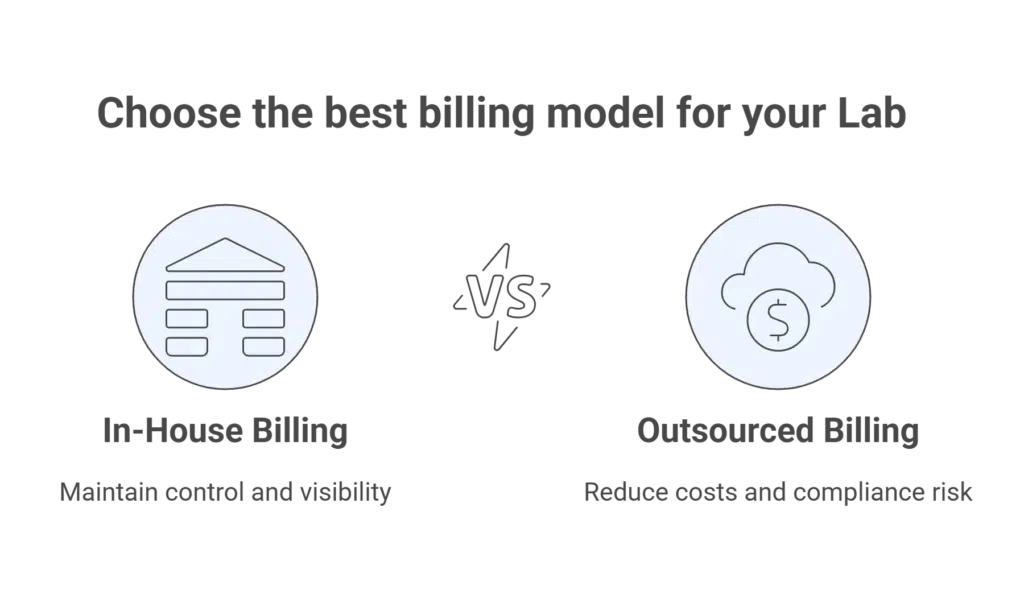
What Is In-House Lab Billing?
In-house lab billing means your laboratory manages all revenue cycle management (RCM) tasks internally using your own staff and billing systems.
Typical responsibilities include:
- Claims generation
- CPT coding and modifiers
- Insurance verification
- Denial management
- Accounts receivable follow-up
- Patient billing
- Revenue reporting
Most laboratories use integrated laboratory billing software or an LIS with RCM functionality to streamline these processes.
Benefits of In-House Lab Billing
Managing billing internally offers several advantages for established laboratories.
1. Greater Control Over Billing Operations
Your team has direct oversight of claims, denials, and payment workflows. This makes it easier to resolve issues quickly.
2. Real-Time Visibility Into Revenue
Labs can monitor claims status, accounts receivable (AR), and collections without waiting for updates from a third-party vendor.
3. Faster Response to Billing Issues
Internal teams can immediately address denied claims, missing information, or payer-related problems.
4. Better Alignment Between Lab and Billing Teams
Because billing staff work closely with laboratory operations, communication is usually more efficient.
5. Lower Long-Term Costs at Scale
For high-volume laboratories, in-house billing can become more cost-effective over time compared to paying recurring outsourcing fees.
Challenges of In-House Lab Billing
While in-house billing offers control, it also comes with operational responsibilities.
1. Higher Staffing Costs
You must hire and train experienced billing specialists, coders, and compliance staff.
2. Ongoing Technology Expenses
Billing software, compliance tools, and system integrations can increase operational costs.
3. Compliance Risks
Incorrect coding or outdated billing practices can lead to denied claims and regulatory issues.
4. Limited Payer Expertise
Internal teams may struggle with payer-specific requirements or complex reimbursement policies.
5. Difficult Scaling
As test volume increases, labs often need additional billing staff and infrastructure.
What Is Outsourced Lab Billing?
Outsourced lab billing involves partnering with a third-party medical billing company to manage some or all of your revenue cycle operations.
Services commonly include:
- Claim submission
- Medical coding
- Payment posting
- Insurance follow-up
- Denial appeals
- AR management
- Financial reporting
Some billing companies use their own systems, while others integrate directly with your existing LIS or RCM platform.
Benefits of Outsourced Lab Billing
Outsourcing can help laboratories reduce operational burdens and accelerate growth.
1. Immediate Access to Billing Experts
Most billing vendors specialize in insurance claims, coding, and reimbursement workflows.
2. Reduced Internal Staffing Requirements
Labs can avoid the cost of hiring, onboarding, and managing a full billing department.
3. Easier Scalability
Outsourced billing providers can typically handle increased test volume without requiring your lab to expand internally.
4. Compliance Support
Many vendors stay updated with payer rules, coding changes, and healthcare regulations.
5. Faster Setup
New or growing labs can launch billing operations quickly without investing heavily in infrastructure.
Challenges of Outsourced Lab Billing
Although outsourcing offers convenience, it can also create limitations.
1. Less Operational Control
Your laboratory may have limited visibility into day-to-day billing activities.
2. Slower Communication
Resolving denials or correcting claims may take longer due to third-party coordination.
3. Reduced Transparency
Some vendors provide limited reporting or restricted access to billing data.
4. Higher Long-Term Costs
Percentage-based collection fees can become expensive as your laboratory grows.
5. Lack of Laboratory-Specific Expertise
Not all medical billing companies specialize in laboratory billing workflows.
In-House vs Outsourced Lab Billing Comparison
| Factor | In-House Billing | Outsourced Billing |
|---|---|---|
| Visibility | High and real-time | Depends on vendor tools |
| Startup Speed | Slower setup | Faster implementation |
| Long-Term Cost | Lower at scale | Higher recurring fees |
| Workflow Control | Full control | Limited control |
| Staffing Needs | Internal hiring required | Managed by vendor |
| Scalability | Requires more staff | Easier scaling |
| Compliance Management | Internal responsibility | Shared with vendor |
| Technology Ownership | Managed internally | Often vendor-managed |
When In-House Billing Is the Better Choice
In-house billing may work best for laboratories that:
- Process high testing volumes
- Already have experienced billing staff
- Use integrated LIS and RCM software
- Want complete operational control
- Prefer long-term cost efficiency
- Plan predictable growth
Laboratories using integrated platforms like Prolis often benefit significantly from in-house billing because data flows directly from testing to claims management.
When Outsourced Billing Makes More Sense
Outsourcing may be ideal for laboratories that:
- Are newly established
- Lack experienced billing personnel
- Need rapid operational setup
- Want to reduce administrative workload
- Are scaling aggressively
- Prefer minimal technology management
For many startup laboratories, outsourcing reduces complexity during early growth stages.
Hybrid Lab Billing Models
Some laboratories choose a hybrid billing approach to balance flexibility and control.
For example, labs may:
- Keep claims generation in-house
- Outsource denial management
- Use consultants for compliance reviews
- Maintain internal oversight while outsourcing collections
This strategy can help reduce overhead while maintaining visibility into financial performance.
Why Technology Matters More Than the Billing Model
Regardless of whether billing is managed internally or externally, success depends heavily on technology and automation.
An integrated LIS and RCM platform can improve:
- Claim accuracy
- Billing speed
- Compliance tracking
- Revenue visibility
- Denial prevention
Laboratories using platforms like Prolis benefit from automated workflows that connect testing, reporting, and billing into one system.
Key advantages include:
- Cleaner claims with fewer errors
- Real-time billing triggers
- Compliance-ready audit trails
- Centralized dashboards for AR and collections
- Faster reimbursement cycles
Even the best billing team cannot perform efficiently with disconnected systems and inaccurate data.
Final Thoughts: Which Lab Billing Model Is Right for You?
Choosing between in-house and outsourced lab billing depends on several factors, including:
- Laboratory size
- Test volume
- Staffing capacity
- Budget
- Growth strategy
- Existing technology
The most important factor is not who submits the claims. It is how effectively your billing workflow captures accurate data, prevents denials, tracks payments, and scales with your laboratory.
Whether you manage billing internally or partner with a vendor, having the right LIS and revenue cycle management system is essential.
With Prolis, laboratories can streamline billing workflows, improve revenue visibility, reduce claim denials, and support long-term profitability.
FAQs
Is outsourced lab billing cheaper than in-house billing?
Outsourced billing can be cheaper initially because it reduces staffing and infrastructure costs. However, high-volume laboratories may save more long-term with in-house billing.
What is the biggest advantage of in-house lab billing?
The biggest advantage is greater control and real-time visibility into billing operations, claims, and collections.
Can laboratories use both in-house and outsourced billing?
Yes. Many labs use a hybrid approach where some billing functions remain internal while others are outsourced.
How does LIS integration improve laboratory billing?
An integrated LIS reduces manual data entry, improves claim accuracy, automates lab workflows, and speeds up reimbursement cycles.
Is Prolis suitable for laboratory billing management?
Yes. Prolis integrates laboratory workflows with billing and revenue cycle management to improve efficiency, visibility, and compliance.