Laboratory Workflow Automation: 8 Processes You Can Automate Today with Modern LIS
Manual laboratory processes are costing clinical labs more than they realize in time, money, compliance risk, and patient outcomes. A mislabeled specimen, a delayed critical value notification, or a billing code error can each cascade into serious consequences. The good news? Modern Laboratory Information Systems (LIS) have evolved to address every one of these pain points through intelligent laboratory workflow automation.
Today’s high-performing labs aren’t just digitizing paper processes they’re systematically eliminating manual touchpoints that introduce variability and error. In this guide, you’ll discover exactly which 8 laboratory processes are ripe for automation right now, what a modern LIS software makes possible, and how to evaluate whether your current system is leaving efficiency on the table.
What Is Laboratory Workflow Automation?
Laboratory workflow automation refers to the use of software, integrated instrumentation, and intelligent rules engines to execute repeatable laboratory tasks with minimal or no manual intervention. Rather than relying on staff to manually enter data, trigger reports, or manage quality control alerts, an automated lab workflow delegates these tasks to a connected system typically anchored by a modern LIS.
Automation in the laboratory context covers a broad spectrum. At one end, you have simple rule-based actions: if a result exceeds a threshold, automatically flag it for review. At the other end, you have fully integrated ecosystems where orders flow in from an EHR, samples are tracked via barcode from collection to result, instruments interface directly with the LIS, results auto-verify against embedded logic, and reports deliver to clinicians without a technologist touching a keyboard.
It is important to distinguish laboratory workflow automation from laboratory automation in the physical sense (robotics, conveyors, automated sample processors). While physical automation is valuable, software-driven workflow automation delivers transformational efficiency gains without the capital expenditure of robotic infrastructure and it can be implemented by nearly any laboratory today.
Why the Distinction Matters
A lab can invest in sophisticated robotics while still losing hours daily to manual report distribution, manual billing code assignment, or manual compliance logging. Conversely, a modestly-sized community lab can deliver elite-level efficiency by automating the right software workflows through a capable LIS. The processes covered in this article fall into the software and workflow category achievable, measurable, and actionable now.
Why Laboratory Workflow Automation Is No Longer Optional
The pressure on clinical laboratories has intensified on multiple fronts simultaneously.
Volume pressure continues to grow. According to industry projections, global laboratory testing volume is expected to grow at over 6% CAGR through 2030, driven by aging populations, expanded chronic disease screening, and point-of-care testing expansion. Laboratories cannot simply hire more staff to meet this demand workforce shortages in medical laboratory science are among the most acute in healthcare.
Accuracy demands are non-negotiable. The consequences of laboratory errors extend far beyond operational inconvenience. Diagnostic errors, many of which have pre-analytical or post-analytical origins rooted in manual processes, contribute to patient harm events. Automation removes the human variability that underlies the majority of these errors.
Reimbursement pressure is tightening. Laboratories face continuous downward pressure on reimbursement rates while operational costs rise. Automation directly addresses the labor cost equation while simultaneously reducing costly rework from errors.
Regulatory scrutiny is increasing. CLIA, CAP accreditation, HIPAA, and state-level laboratory regulations require rigorous documentation, quality control, and audit trails that are simply impractical to maintain manually at scale.
Turnaround time (TAT) is a competitive differentiator. Whether serving hospital inpatients, emergency departments, or outpatient clinics, faster TAT directly impacts patient care decisions and clinician satisfaction. Laboratory workflow automation is the single most impactful lever for reducing TAT.
8 Laboratory Processes You Can Automate Today
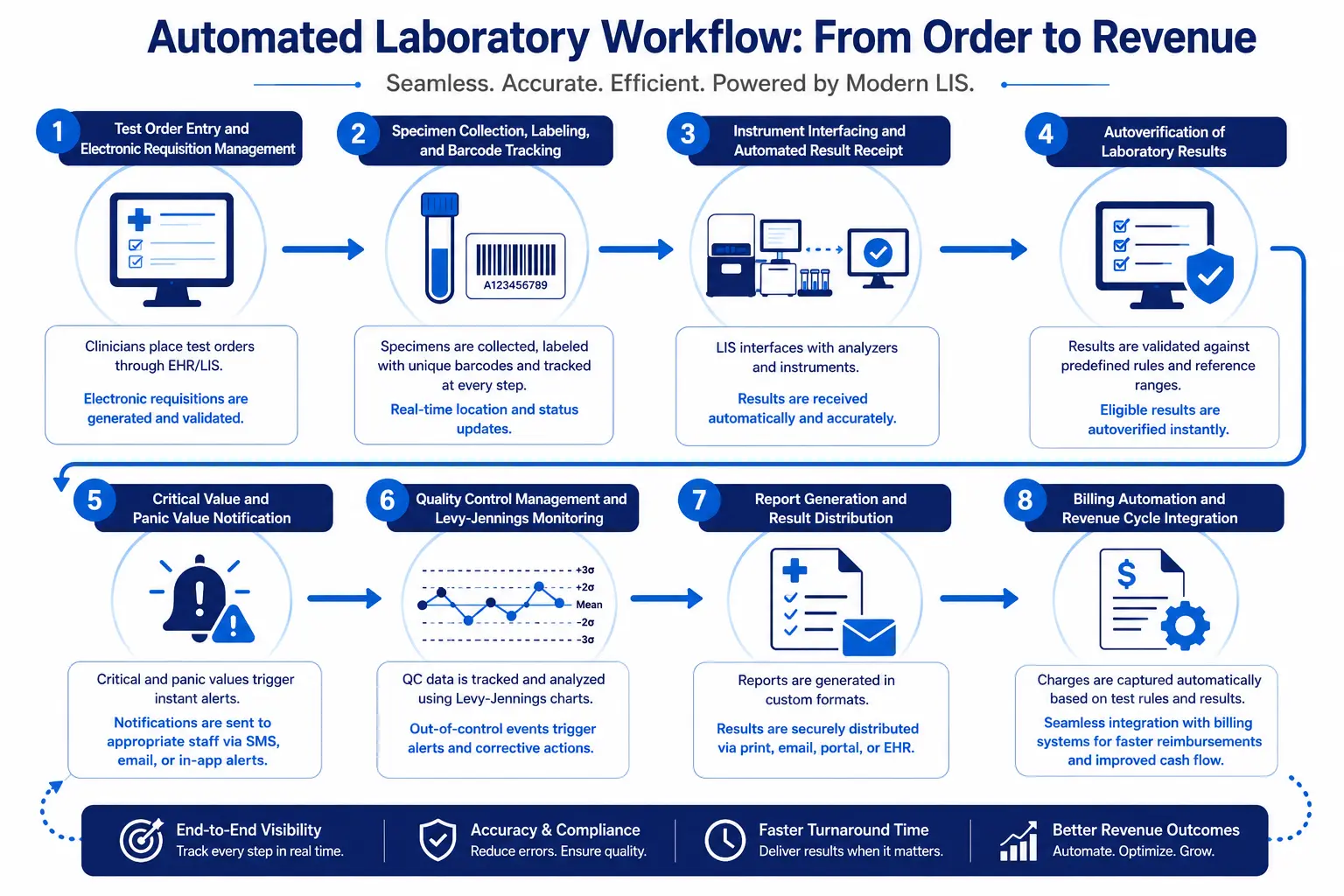
1. Test Order Entry and Electronic Requisition Management
Manual order entry is one of the highest-risk touchpoints in the pre-analytical phase. Handwritten requisitions introduce transcription errors, illegible physician notes, and missing clinical information. Duplicate orders go undetected. Incomplete demographics cause downstream billing failures.
What automation enables: A modern LIS integrates bidirectionally with EHR and EMR systems via HL7 or FHIR interfaces, receiving electronic orders directly from ordering providers. Order entry automation means:
- Orders populate the LIS automatically from the physician’s EHR without re-keying
- Duplicate order detection fires in real time, alerting staff before unnecessary testing occurs
- Mandatory field validation prevents incomplete requisitions from advancing in the workflow
- Insurance eligibility checks run automatically at the point of order, reducing claim denials
- Standing orders and reflex panels configure once and execute automatically based on clinical rules
The result is a clean, complete, electronic order that flows through the entire workflow without manual intervention at this stage.
Impact: Labs implementing electronic order interfaces routinely report a 40–60% reduction in order-related errors and significant reduction in phone calls from front-end staff chasing missing information.
2. Specimen Collection, Labeling, and Barcode Tracking
The specimen journey from patient to analyzer is fraught with manual risk. Mislabeled specimens represent the most common pre-analytical error in clinical laboratories, with studies estimating that labeling errors occur in 0.1–1% of all specimens a significant number when scaled across thousands of daily accessions.
What automation enables: Modern LIS platforms support automated specimen labeling and end-to-end barcode tracking. Automated collection workflows include:
- Patient identification verification at the point of collection via electronic wristband scanning
- Automatic generation of uniquely barcoded specimen labels tied to the electronic order
- Collection confirmation logged directly in the LIS with time-stamp and collector ID
- Chain-of-custody tracking from collection through processing, analysis, and storage
- Specimen location tracking for quick retrieval and add-on test processing
Many modern systems support mobile collection apps that sync with the LIS in real time, ensuring that collection data is immediately available for tracking and TAT calculation.
Impact: Automated specimen tracking has been shown to reduce labeling errors by over 80% in laboratories that implement barcode-driven collection workflows. Simultaneously, “lost specimen” events which are extraordinarily costly to manage and damaging to patient and clinician relationships are virtually eliminated.
3. Instrument Interfacing and Automated Result Receipt
One of the most impactful and most frequently underutilized automation opportunities in laboratory workflow is bidirectional instrument interfacing. Many laboratories continue to transcribe analyzer results manually into their LIS, despite the availability of direct electronic interfaces.
What automation enables: A fully interfaced LIS communicates bidirectionally with laboratory analyzers across all disciplines chemistry, hematology, coagulation, microbiology, urinalysis, immunology, and more. This means:
- Test orders transmit automatically from the LIS to the analyzer when a specimen is loaded
- Results return electronically from the analyzer to the LIS with no manual transcription
- QC data flows automatically for real-time quality monitoring
- Dilution factors, repeat flags, and instrument comments pass through the interface
- Multi-analyzer routing logic directs specimens to the appropriate instrument based on configured rules
Bidirectional interfaces remove the most error-prone step in result processing manual transcription and accelerate TAT by eliminating the queue created when staff must manually enter data between analyzer review and LIS posting.
Impact: Manual transcription errors are reduced to zero for interfaced tests. Average TAT improvements of 15–30 minutes per batch have been documented in labs transitioning from manual entry to full instrument interfacing.
4. Autoverification of Laboratory Results
Autoverification also known as auto-release or automated result approval is one of the most sophisticated and highest-value automation capabilities in a modern LIS. It applies a configurable rules engine to incoming results and, when all criteria are satisfied, releases results to the ordering provider without requiring technologist review of every individual result.
This is not a shortcut around quality. Rather, it is the LIS doing precisely what a trained technologist would do checking a comprehensive list of criteria and only releasing results that meet every criterion. Results that trigger any exception flag are routed to manual review.
What automation enables: A robust autoverification engine checks results against:
- Reference range validation (patient age, sex, and diagnosis-adjusted ranges)
- Delta check comparison against the patient’s previous results
- Critical value flags requiring immediate notification
- Instrument QC status verification
- Panic value thresholds requiring escalation protocols
- Implausible value detection (results physiologically incompatible with life)
- Instrument flags and review codes
Results that pass all checks release automatically. Those that fail any check queue for technologist review with the specific flag clearly displayed.
Impact: Laboratories with mature autoverification programs routinely achieve 60–85% auto-release rates, meaning the majority of normal results flow to providers without technologist touch. This dramatically reduces TAT and frees highly trained staff to focus on complex cases requiring genuine clinical judgment.
5. Critical Value and Panic Value Notification
Managing critical value notifications manually is both operationally burdensome and compliance-critical. CLIA and CAP standards require laboratories to document timely notification of critical results to responsible clinicians. Manual phone-based critical value notification workflows are time-consuming, inconsistently documented, and difficult to audit.
What automation enables: Modern LIS platforms automate the critical value notification workflow end-to-end:
- Critical and panic values trigger automatic alerts the instant a result exceeds configured thresholds whether released manually or through autoverification
- Automated notification pathways contact the ordering provider, covering physician, or nursing unit via the configured escalation chain
- Callback documentation captures the notified party, time of notification, and read-back confirmation directly in the LIS
- Escalation timers automatically advance to the next contact if no acknowledgment is received within the configured timeframe
- Complete audit trails generate automatically, satisfying CAP and CLIA documentation requirements
Impact: Automated critical value management eliminates the documentation gaps that cause laboratories to fail accreditation reviews. More importantly, it ensures that life-threatening results reach the right clinician faster, enabling time-critical clinical interventions.
6. Quality Control Management and Levy-Jennings Monitoring
Quality control in the clinical laboratory is not optional it is the scientific foundation of every result the laboratory produces. Yet managing QC manually across dozens of instruments, hundreds of analytes, and multiple QC materials is extraordinarily time-intensive. Westgard rule violations buried in paper QC logs are often caught too late, meaning patient results may have been released during a period of analytical error.
What automation enables: Integrated QC management within a modern LIS transforms quality oversight:
- QC results transmit directly from instruments via interface, populating QC charts automatically
- Westgard rules (1-2s, 1-3s, 2-2s, R-4s, 4-1s, 10x) apply automatically to each QC run
- Levy-Jennings charts generate and update in real time for visual trending
- QC rule violations trigger immediate alerts and, critically, can lock the LIS from releasing patient results on the affected analyte until the issue is resolved
- Monthly QC statistics, standard deviation calculations, and coefficient of variation reports generate automatically
- Peer comparison data integrates for ongoing method performance benchmarking
Impact: Automated QC management catches analytical errors earlier often before any patient results are affected. Laboratories consistently report that QC automation reduces the time technologists spend on QC documentation by 50–70%, while improving the rigor of QC monitoring.
7. Report Generation and Result Distribution
In many laboratories, result reporting remains surprisingly manual. Staff print reports, fax results to physician offices, or manually attach documents to EMR encounters. This is not only inefficient it introduces delay and creates HIPAA exposure every time an unencrypted fax is involved.
What automation enables: Modern LIS platforms support fully automated report generation and multi-channel result distribution:
- Final reports generate automatically upon result release, formatted to client-specific templates
- HL7 result messages transmit directly into the ordering EHR, appearing in the patient’s chart without any manual action
- Physician portal access provides secure real-time result viewing from any device
- Automated fax delivery to configured recipients for facilities without EHR interfaces
- Custom report formats for different client types (hospitals, physician offices, long-term care facilities, direct-to-consumer)
- Cumulative reports compile a patient’s result history automatically
- Critical value reports flag and escalate through the notification workflow described above
- Amended report generation automatically republishes corrected results with amendment notations
Impact: Automated result distribution eliminates the 15–45 minutes per batch that laboratory staff spend printing, sorting, faxing, and scanning reports in manual environments. It also dramatically reduces turnaround time for ordering providers, improving clinical satisfaction and laboratory competitive positioning.
8. Billing Automation and Revenue Cycle Integration
Laboratory billing is among the most complex billing environments in healthcare. Accurate charge capture requires correct CPT code assignment, ICD-10 diagnosis linking, payer-specific modifier application, medical necessity validation, and precise documentation all applied to hundreds of test orders daily. Manual billing processes result in charge leakage, claim denials, and compliance risk.
What automation enables: A modern LIS with integrated billing automation handles revenue cycle processes systematically:
- CPT codes map automatically to ordered tests without manual charge entry
- ICD-10 diagnosis codes link from the electronic order, satisfying medical necessity requirements
- Payer-specific rules engines apply correct modifiers, billing codes, and bundling logic automatically
- ABN (Advance Beneficiary Notice) requirements trigger automatically for Medicare patients when medical necessity may not be met
- Claims generate directly from the LIS upon result release, eliminating the billing lag inherent in manual charge submission
- Claim scrubbing runs before submission, catching formatting errors and missing information that would cause denials
- ERA (Electronic Remittance Advice) auto-posting matches payments to claims automatically
- Denial management workflows route rejected claims for review with denial reason codes pre-populated
Impact: Laboratories implementing LIS-integrated billing automation typically report 25–40% reductions in claim denial rates and significant reductions in days in accounts receivable. Perhaps more importantly, charge leakage from manual missed-charge scenarios is eliminated meaning the laboratory captures revenue it was previously providing without reimbursement.
How a Modern LIS Powers Laboratory Workflow Automation
The 8 processes described above share a common dependency: a capable, modern Laboratory Information System at the center. Not all LIS platforms are created equal in their automation capabilities. Understanding what to look for is essential to selecting a LIS system vendor that will deliver the efficiency gains your laboratory needs.
Core LIS Automation Architecture
A modern LIS designed for workflow automation operates on several foundational principles:
Bidirectional integration: The LIS must communicate in real time with EHR systems, billing platforms, reference laboratories, instruments, and middleware using current standards (HL7 v2, HL7 FHIR, ASTM). One-way or batch-interface architectures create data lag that undermines automation goals.
Rules engine sophistication: Autoverification, critical value logic, QC rule application, and billing logic all depend on a powerful, configurable rules engine. Look for systems that support complex conditional logic, not just simple threshold comparisons.
Real-time processing: Automation loses its value if the system processes data in batches rather than in real time. Modern LIS platforms process orders, results, and alerts as events occur.
Workflow configurability: Every laboratory’s workflow is different. The LIS must be configurable to match your specific workflow without requiring custom development for every variation.
Comprehensive audit trails: Automation must generate defensible documentation. Every automated action order receipt, result release, QC evaluation, critical value notification must be logged with timestamp, action taken, and system or user responsible.
Manual vs. Automated Laboratory Workflows: A Comparison
| Process | Manual Workflow | Automated LIS Workflow | Efficiency Gain |
|---|---|---|---|
| Order Entry | Staff re-key physician orders from paper/fax | Orders received electronically from EHR via HL7 | 100% reduction in transcription errors |
| Specimen Labeling | Manual label generation and application | Barcode labels auto-generated from electronic order | 80%+ reduction in labeling errors |
| Result Entry | Technologists transcribe from analyzer printouts | Results received via bidirectional instrument interface | Transcription errors eliminated |
| Result Review | 100% manual review of every result | Auto-verification releases 60-85% without touch | 60-85% reduction in review workload |
| Critical Value Notification | Phone calls with paper log | Automated alerts with built-in documentation | Faster notification, compliant documentation |
| QC Monitoring | Manual Levy-Jennings charting, paper logs | Automated chart generation, real-time rule violation alerts | 50-70% reduction in QC documentation time |
| Report Distribution | Print, fax, or scan to EMR manually | Auto-generated reports via HL7 to EHR, portals, fax | Near-zero manual distribution labor |
| Billing Charge Capture | Manual charge entry and code assignment | Automated CPT/ICD-10 mapping and claim generation | 25-40% reduction in denial rates |
Why Modern Laboratories Need Automation
The demand for diagnostic testing continues to increase every year. At the same time, laboratories must maintain strict quality standards while delivering faster turnaround times.
Without automation, laboratories commonly face:
- Manual data entry mistakes
- Lost or mislabeled specimens
- Delayed reporting
- Poor resource utilization
- Compliance challenges
- Higher operational costs
Workflow automation addresses these issues by creating standardized digital processes that improve both efficiency and accuracy.
Key benefits include:
- Faster sample processing
- Reduced human errors
- Improved patient safety
- Better staff productivity
- Enhanced regulatory compliance
- Real-time operational visibility
Why Prolis LIS Is an Ideal Choice for Laboratory Workflow Automation
For laboratories seeking a modern LIS specifically designed to deliver comprehensive workflow automation, Prolis LIS software represents a purpose-built solution aligned with the eight automation categories described throughout this article.
Prolis LIS is built on a modern, cloud-capable architecture that enables the kind of real-time, bidirectional integration that laboratory workflow automation demands. Rather than adapting a legacy system to modern automation requirements, Prolis was designed from the ground up for the workflow realities that today’s clinical laboratories face.
Key Prolis LIS automation capabilities include:
- Bidirectional EHR/EMR interfaces via HL7 supporting major EHR platforms, enabling electronic order receipt and result delivery without manual intervention
- Comprehensive instrument interfacing with a broad library of certified connections to major analyzer manufacturers across chemistry, hematology, microbiology, and more
- Configurable autoverification engine allowing laboratory staff to build and modify result-release rules without dependence on vendor customization
- Integrated QC management with automated Westgard rule application, real-time Levy-Jennings charting, and result-hold logic when QC fails
- Automated critical value notification with built-in escalation protocols and documentation capture that satisfies CAP and CLIA accreditation requirements
- Automated report generation and distribution via provider portals, HL7 outbound interfaces, and configured fax routing
- Integrated billing automation with CPT and ICD-10 mapping, payer-specific rules, and direct claim generation to reduce denial rates and accelerate revenue cycle
Prolis also prioritizes implementation support recognizing that the most sophisticated automation platform delivers no value if not implemented correctly. The Prolis team provides structured implementation support, validation documentation, and ongoing optimization guidance to ensure laboratories reach their automation goals rather than simply activating features.
For laboratories evaluating their LIS options with workflow automation as a priority, Prolis LIS merits serious consideration as a platform designed for exactly this purpose.
Key Takeaway
Laboratory Workflow Automation is no longer a luxury it’s a necessity for laboratories aiming to improve efficiency, reduce errors, and deliver faster, more reliable diagnostic services. By automating processes such as patient registration, sample tracking, quality control, result validation, and reporting, laboratories can achieve higher productivity while maintaining compliance and accuracy. Solutions like Prolis LIS provide an integrated platform that supports end-to-end automation, helping diagnostic centers and hospitals build smarter, scalable, and future-ready laboratory operations.