Avoiding Revenue Leakage with End-to-End LIS Billing Integration
Key takeaway: Most laboratory revenue leakage isn’t caused by bad payers or bad luck it’s caused by disconnected systems. When your Laboratory Information System (LIS) and your billing platform don’t talk to each other in real time, unbilled tests, coding mismatches, and unresolved denials quietly drain profit every single month. End-to-end LIS billing integration closes that gap by connecting the moment a test is ordered to the moment it’s paid.
What This Guide Covers
If you run or manage billing for a clinical, reference, toxicology, molecular, or pathology lab, this guide walks through exactly where revenue leakage happens, how integrated LIS billing prevents it, what the financial impact looks like in real numbers, and how to evaluate whether your current setup is costing you more than you realize.
What Is Revenue Leakage in a Laboratory?
Revenue leakage is the gradual, often invisible loss of income a lab has already earned but never fully collects. Unlike a single large billing error, leakage rarely shows up as one dramatic loss it accumulates from dozens of small breakdowns across the testing and billing lifecycle.
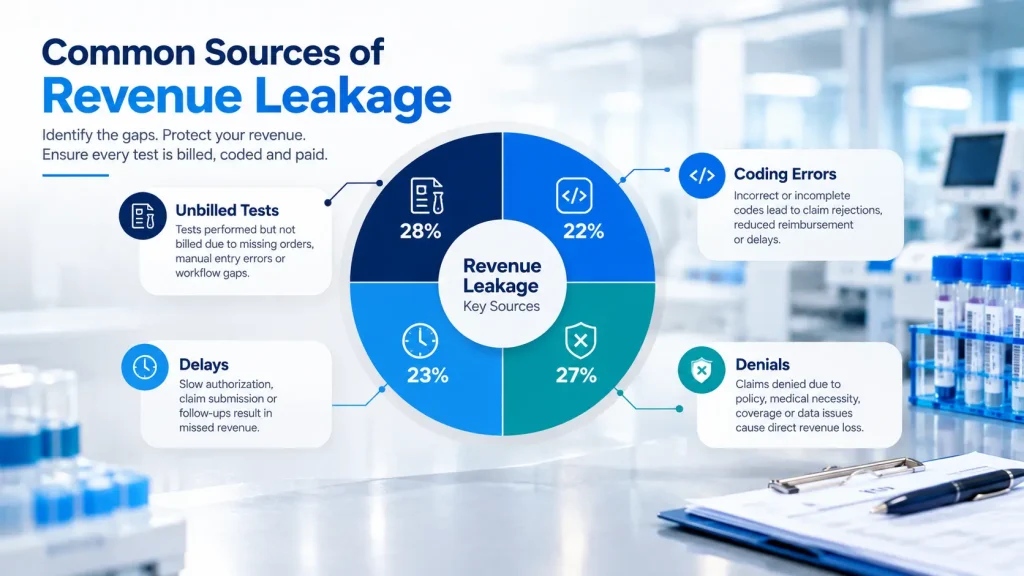
In a laboratory setting, revenue leakage typically comes from:
- Unbilled tests — accessioned specimens or completed results that never generate a claim because of missing data or manual oversight.
- Coding and demographic errors — mismatched CPT/ICD-10 codes, incorrect patient or provider information re-keyed between systems.
- Delayed billing — claims that sit for days or weeks because results aren’t automatically flagged as billing-ready.
- Denied claims that are never reworked — industry research shows a large share of denied claims are simply written off rather than appealed.
- Missing documentation — inability to prove medical necessity or produce an audit trail when a payer requests it.
- Poor AR visibility — no clear picture of which claims are pending, denied, or aging past a recoverable window.
Why Revenue Leakage Is So Common in Labs Specifically
Labs process high volumes of discrete, billable events often thousands of tests a month across many payers, panels, and referring providers. That volume, combined with strict payer-specific coding rules and tight documentation requirements, creates more points of failure than almost any other part of a healthcare organization’s revenue cycle. When the LIS and the billing system are separate platforms connected by manual exports, spreadsheets, or re-keyed data, every one of those points of failure becomes a leakage risk.
The Real Cost of Leakage: A Simple Math Exercise
Revenue leakage rarely feels urgent because it’s spread thin. But the math adds up quickly.
| Scenario Input | Value |
|---|---|
| Tests processed per month | 3,000 |
| Leakage rate (unbilled/underpaid) | 5% |
| Tests affected per month | 150 |
| Average reimbursement per test | $50 |
| Monthly revenue lost | $7,500 |
| Annualized loss | $90,000+ |
That figure doesn’t include the additional cost of reworking denied claims. Independent industry benchmarking puts the average cost of reworking a single denied claim between roughly $25 and $118 depending on complexity, and reports that the industry-wide initial claim denial rate reached 11.8% in 2024, up from 10.2% a few years earlier with more than four in ten providers now seeing denial rates above 10% of total claims. A meaningful share of those denials, once issued, are never appealed at all meaning the revenue is simply gone.
Where Revenue Leakage Happens Across the Testing Lifecycle
To understand why integration matters, it helps to map leakage against the actual workflow of a lab test from order to payment.
| Workflow Stage | Leakage Risk Without Integration |
|---|---|
| Order & accession | Missing or incomplete accession data prevents billing entirely |
| Testing & result finalization | Delayed handoff to billing because staff must manually flag “billable” results |
| Coding | CPT/ICD-10 codes re-entered by hand instead of pulled from the test panel |
| Claim submission | Payer-specific rules (modifiers, medical necessity, prior auth) not validated pre-submission |
| Payer adjudication | No real-time visibility into denials, so issues surface weeks later |
| Appeals & documentation | Supporting order/result/coding records scattered across systems, slowing audit response |
How End-to-End LIS Billing Integration Prevents Revenue Loss
End-to-end LIS billing integration means your billing workflow lives inside or is tightly synchronized with the same system that manages orders, accessioning, testing, and result reporting. Instead of billing being a downstream, manual process, it becomes a real-time extension of lab operations. Here’s how that structurally closes the leakage points above.
1. Billing Triggers Automatically on Finalized Results
In disconnected labs, a completed test doesn’t automatically become a claim someone has to notice it, flag it, and hand it off. Every extra step is a chance for a test to fall through the cracks. Integrated systems trigger the billing workflow the moment a result is marked final, which means:
- No completed test goes unbilled because of a missed manual step.
- Claims move to submission faster, shrinking the time between service and payment.
- Days in accounts receivable (AR days) drop because the clock starts sooner.
2. Manual Data Duplication Is Eliminated
Every time patient demographics, test codes, or provider details are copied by hand from the LIS into a separate billing tool, there’s a chance for a typo, transposed digit, or outdated field to slip through and a single mismatched detail is often enough to trigger a denial. With integration:
- Patient demographic data syncs automatically between systems.
- CPT and ICD-10 codes flow directly from the ordered test panel.
- Referring provider identifiers, including NPI, auto-populate from the order record.
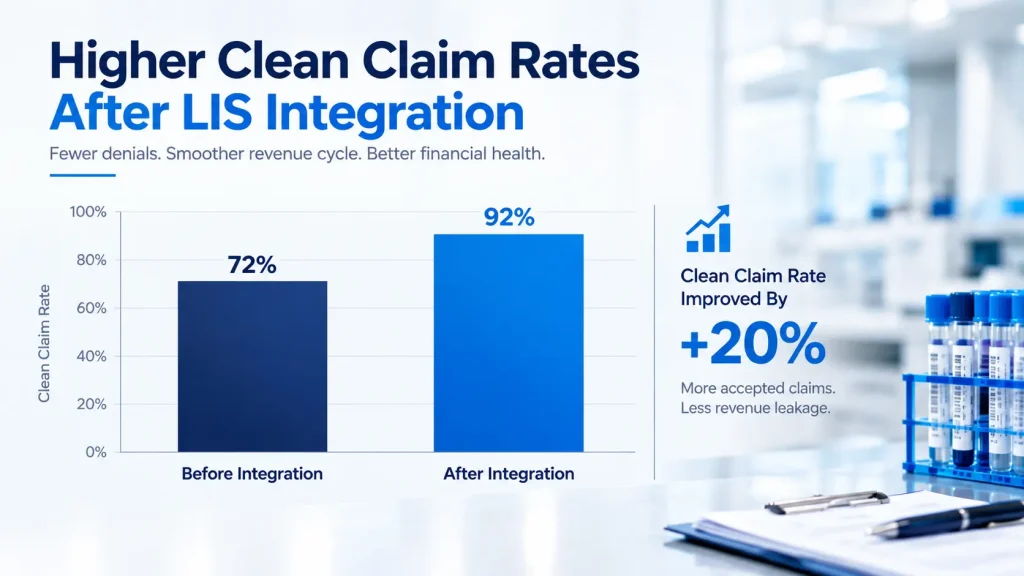
Result: fewer transcription errors and a measurably higher first-pass (clean) claim acceptance rate.
4. Built-In Payer Rule Validation
Every payer has its own rulebook required modifiers, diagnosis-to-procedure matching, medical necessity thresholds, and prior authorization requirements. Integrated LIS billing platforms can apply those payer-specific edits before a claim ever leaves the building, catching problems the same way a clearinghouse scrubber would, but earlier in the process. That includes:
- Confirming diagnosis codes support the ordered test (medical necessity).
- Flagging claims missing required documentation before submission.
- Applying the correct modifiers automatically based on payer and test type.
5. Audit-Ready Documentation and Chain of Custody
Every claim a lab submits should be defensible tied to a specific order, result, and coding justification. When those pieces live in separate, poorly linked systems, reconstructing that trail during a payer audit or compliance review can take hours per claim. An integrated LIS keeps the order, the result, the documentation, and the coding logic connected automatically, producing a digital chain of custody for every billed service and making audit response dramatically faster.
6. Real-Time Visibility into AR and Billing Status
You can’t fix leakage you can’t see. Integrated LIS platforms typically provide dashboards showing:
- Which claims are pending, paid, or denied, updated in near real time.
- Outstanding accounts receivable broken down by payer.
- Revenue performance by test type or panel.
- Billing lag by ordering provider or client account.
This kind of visibility turns billing from a reactive, end-of-month scramble into an ongoing, proactive process catching a leak while it’s still small instead of finding it three months later during a financial review.
Why Denial Trends Make Integration More Urgent, Not Less
Some labs assume billing integration is a “nice-to-have” upgrade rather than a financial necessity. Recent payer trends argue otherwise. Reporting based on Experian Health’s 2025 State of Claims survey found that claim denial rates have climbed for several consecutive years, and Medicare Advantage and Medicaid managed-care plans in particular are denying a growing share of claims through more aggressive prior-authorization and clinical-editing rules. Roughly three-quarters of those denials trace back to administrative issues missing data, mismatched codes, expired authorizations not genuine coverage disputes.
In other words, most denials are preventable at the point of claim creation. That is precisely the layer where LIS billing integration operates.
In-House vs. Outsourced Billing: Does Integration Still Matter?
Whether a lab bills in-house or works with an outsourced billing partner, the same principle applies: billing is only as accurate as the data feeding it. An integrated LIS ensures that every claim regardless of who ultimately submits it is built from clean, synchronized, billing-ready data rather than a manually assembled export.
| Model | Where Integration Helps Most |
|---|---|
| In-house billing team | Reduces manual entry, speeds claim creation, gives staff real-time denial visibility |
| Outsourced billing / RCM partner | Delivers clean, structured data to the partner, reducing back-and-forth clarification requests and rework |
What Good Looks Like: Benchmarks for Integrated Lab Billing
Labs that move from disconnected, manual billing to end-to-end LIS billing integration commonly report improvements such as:
- Clean (first-pass) claim rates in the 85–95% range.
- Billing lag reduced by roughly 30–50%.
- Lower denial and resubmission volume.
- Faster visibility into unpaid or aging claims.
- Improved revenue capture without adding billing headcount.
These figures are directional benchmarks, not guarantees actual results depend on payer mix, test complexity, and how thoroughly the integration covers the order-to-cash workflow.
A Practical Checklist: Is Your Lab Leaking Revenue Right Now?
Use this quick self-audit to gauge exposure. If you answer “yes” to two or more, integration should be a near-term priority.
- Do staff manually flag results as “ready to bill” rather than the system doing it automatically?
- Is patient or provider data re-typed into a separate billing system?
- Do you lack a real-time dashboard showing denied or aging claims by payer?
- Would it take more than a few minutes to pull the full order-result-coding trail for a single claim during an audit?
- Have you never calculated your lab’s actual unbilled/underpaid test percentage?
How Prolis Approaches End-to-End LIS Billing Integration
Prolis builds billing directly into the lab operations workflow rather than treating it as a bolt-on afterthought. In practice, that means:
- Claim workflows begin inside the LIS the moment a result is finalized.
- Payer-specific rules are embedded at the test-configuration level.
- Billing-ready data demographics, codes, provider identifiers is generated automatically with every test.
- Reporting tracks rejected claims and aging AR in one place.
- Data exports cleanly to clearinghouses or internal/outsourced RCM teams.
The goal is the same whether a lab is a physician office lab, a reference lab, a toxicology lab, or a pathology lab: make sure nothing between “test ordered” and “claim paid” depends on someone remembering to do a manual step.
Conclusion: Control Your Revenue Don’t Chase It
Every unbilled test, every denied claim left unresolved, and every re-keyed data field is a small tax on a lab’s profitability. None of it is dramatic on its own and that’s exactly why it’s so easy to ignore until the annualized total shows up in a financial review. End-to-end LIS billing integration replaces that slow leak with a connected, auditable, real-time system that turns billing from a downstream chore into a built-in safeguard for revenue.
Ready to see where your lab is leaking revenue? Book a Prolis demo to walk through your current billing workflow and identify where automation would have the biggest immediate impact on your clean claim rate and AR days.