
In-House vs Outsourced Medical Billing: Which Model Is Right for Your Practice?
If your practice is bleeding revenue to denied claims, slow reimbursements, or an overworked billing team, you’ve probably asked the question every practice owner eventually asks: should we keep billing in-house, or hand it off to a medical billing company?
There’s no one-size-fits-all answer. A five-provider dermatology group and a 40-bed hospital have completely different staffing budgets, claim volumes, and risk tolerances. What works for one can quietly drain the other.
This guide breaks down in-house vs outsourced medical billing in practical terms real costs, collection performance, compliance responsibilities, and the questions that actually determine which model fits your practice. By the end, you’ll have a clear framework for making this decision instead of a coin flip.
What Is In-House Medical Billing?
In-house medical billing means your practice employs its own staff to handle the entire billing cycle from the moment a patient checks in to the moment a claim is paid. Your team works inside your practice management software, follows your protocols, and reports directly to your office manager or administrator.
Typical in-house billing responsibilities include:
- Patient registration and insurance eligibility verification
- Medical coding (CPT, ICD-10, HCPCS) and charge entry
- Claim scrubbing and submission
- Payment posting and reconciliation
- Denial management and appeals
- Patient statements and collections
- Accounts receivable (A/R) follow-up
What Is Outsourced Medical Billing?
Outsourced medical billing means you contract a third-party company a revenue cycle management (RCM) firm to manage some or all of these same functions. The billing company typically charges a percentage of collections (commonly 4%–9%) or a flat per-claim fee, and works either inside your existing EHR/practice management system or its own proprietary platform.
Most outsourced billing partners offer:
- Certified coders (AAPC or AHIMA credentialed)
- Dedicated denial management and appeals teams
- Payer-specific claims expertise across multiple states
- Reporting dashboards for collections, A/R aging, and denial trends
- Compliance monitoring for coding and payer rule changes
In-House vs Outsourced Medical Billing: Side-by-Side Comparison
| Factor | In-House Billing | Outsourced Billing |
|---|---|---|
| Upfront cost | High (hiring, software, hardware) | Low to moderate (setup/integration fee) |
| Ongoing cost structure | Fixed (salaries, benefits, licenses) | Variable (% of collections or per claim) |
| Staffing risk | High — turnover disrupts cash flow | Low — vendor manages staffing |
| Visibility & control | Full, real-time | Depends on vendor’s reporting tools |
| Coding & compliance expertise | Limited to what you train internally | Typically specialized and continuously updated |
| Scalability | Requires hiring as volume grows | Scales without added headcount |
| Best suited for | Large practices with steady volume and existing billing infrastructure | Small to mid-size practices, new practices, or those with high denial rates |
The Real Cost of In-House Medical Billing
Most practices underestimate what an in-house billing department actually costs, because they only budget for salary. The full picture looks different.
1. Direct Labor Costs
A single experienced medical biller’s fully loaded cost salary, payroll tax, health benefits, and paid time off often runs well into six figures annually once you factor in a coder and a billing manager for oversight. Multiply that across a two- or three-person billing team, and the number grows fast.
2. Technology and Infrastructure
Practice management software, clearinghouse fees, coding reference tools, and secure workstations all carry recurring costs regardless of how many claims you actually process that month.
3. Turnover and Training
Billing is a specialized skill, and turnover is common. Every time a biller leaves, claims slow down while a replacement is hired and trained on your specific payer mix and workflows. That gap often shows up weeks later as a dip in collections.
4. Compliance Exposure
Coding errors, upcoding, or missed timely-filing deadlines carry financial and legal risk. Keeping staff current on annual CPT/ICD-10 updates and payer policy changes requires ongoing training investment.
The Real Cost of Outsourced Medical Billing
Outsourcing shifts most of these costs from fixed to variable, but it isn’t free of trade-offs.
1. Percentage-of-Collections Fees
Most billing companies charge a percentage of what they collect, so the fee scales with your revenue. This can look inexpensive for a smaller practice and expensive for a high-volume one the math needs to be run both ways before signing a contract.
2. Setup and Integration Fees
Migrating historical claims data and integrating with your EHR typically involves a one-time onboarding cost, which is far lower than building an in-house department from scratch.
3. Reduced Day-to-Day Control
You won’t have a billing team sitting down the hall. Communication happens through calls, emails, or a client portal, which can slow down urgent fixes if the vendor isn’t responsive.
Performance: Denial Rates, A/R Days, and Collections
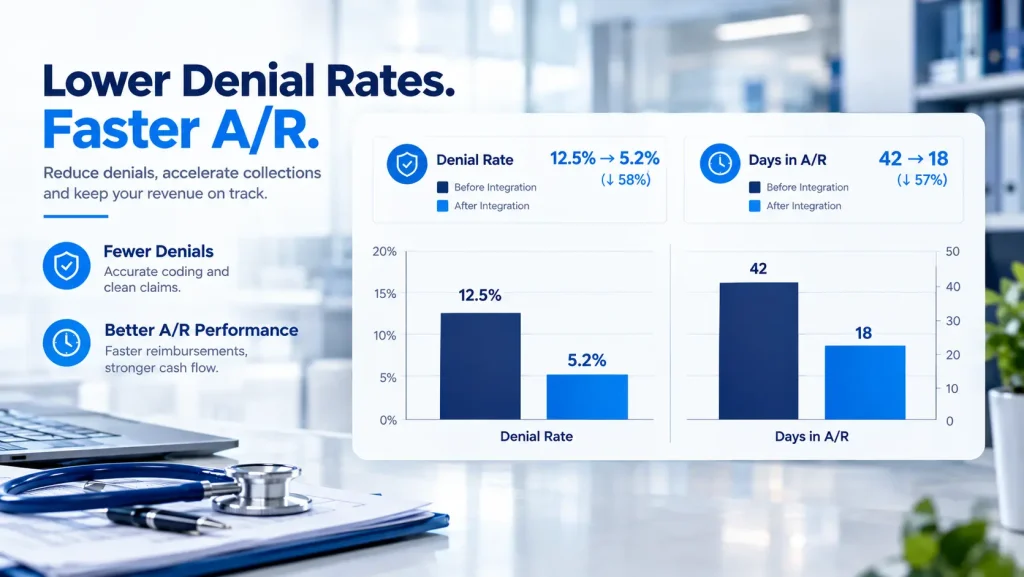
Cost is only half the story billing performance drives the other half of your revenue. The metrics that matter most when comparing models are:
- Clean claim rate — the percentage of claims accepted on first submission, without errors
- Denial rate — the percentage of claims rejected or denied by the payer
- Days in A/R — how long it takes, on average, to get paid after a claim is submitted
- Net collection rate — the percentage of allowed charges actually collected
Practices with dedicated, specialized billing teams whether in-house or outsourced consistently outperform practices where billing is treated as a side task for front-desk staff. The determining factor isn’t strictly “in-house vs outsourced”; it’s whether the team doing the work has the training, technology, and bandwidth to chase every claim aggressively. That said, established outsourced RCM firms tend to have an edge on denial prevention simply because payer-rule expertise is their full-time job across hundreds of clients, not one practice.
When In-House Billing Makes Sense
In-house billing tends to work best for practices that:
- Already have an experienced, stable billing team in place
- Process high claim volume, where fixed costs are spread across more revenue
- Want real-time visibility into every claim and patient account
- Have the budget for ongoing software, training, and compliance investment
- Operate in a specialty with straightforward, predictable coding
When Outsourced Medical Billing Makes Sense
Outsourcing tends to make more sense for practices that:
- Are newly established and don’t yet have billing infrastructure
- Have a small staff wearing multiple hats, including billing
- Are struggling with high denial rates or slow reimbursements
- Bill for complex specialties (behavioral health, multi-specialty, surgery) with frequent coding changes
- Want to convert a fixed administrative cost into a variable one tied to revenue
- Are scaling quickly and don’t want billing to become a hiring bottleneck
Hybrid Billing: A Middle-Ground Option
Many practices don’t choose one model exclusively they blend both. A hybrid approach might look like:
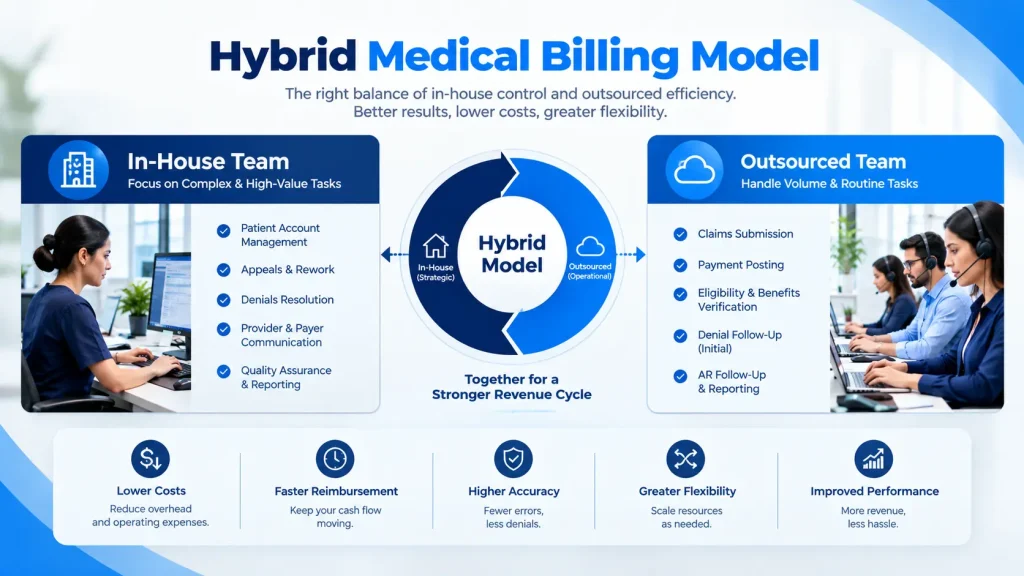
- Keeping patient check-in, eligibility verification, and coding in-house
- Outsourcing claim submission and denial management to a specialist vendor
- Using an outsourced partner only for aging A/R over 90 days
- Bringing in a billing consultant for periodic audits while staff handle daily operations
This structure lets practices retain control over patient-facing processes while offloading the most specialized, error-prone parts of the revenue cycle.
Compliance and Data Security: Who’s Responsible?
Regardless of which model you choose, your practice remains legally responsible for HIPAA compliance and accurate billing under federal law. If you outsource, that responsibility doesn’t disappear it becomes a shared obligation defined by your Business Associate Agreement (BAA). Before signing with any billing vendor, confirm:
- They sign a BAA and can demonstrate HIPAA-compliant data handling
- They carry errors and omissions (E&O) insurance
- They provide audit trails and coding documentation you can review
- Their staff are certified coders, not just data-entry personnel
Questions to Ask Before Choosing a Billing Model
- What is our current denial rate, and what’s causing it?
- How much would a fully staffed in-house team cost us annually, including benefits and turnover risk?
- What percentage fee would an outsourced vendor charge, and how does that compare at our current and projected revenue?
- How much visibility and reporting do we actually need day-to-day?
- Does our specialty have coding complexity that benefits from dedicated expertise?
- How quickly are we planning to grow, and which model scales with that growth more easily?
Final Thoughts: Making the Right Call for Your Practice
Choosing between in-house vs outsourced medical billing isn’t really about which model is universally better it’s about matching the model to your practice’s size, growth stage, and internal capacity. High-volume, well-staffed practices often retain more value by keeping billing in-house. Smaller or growing practices frequently see faster, more predictable cash flow by outsourcing to a specialized partner.
Whichever direction you choose, the real driver of revenue performance is the same: accurate coding, fast claim submission, and relentless follow-up on denials. Run the numbers for your specific practice, ask vendors for references and performance data, and don’t be afraid to start with a hybrid model while you learn what fits.
Ready to evaluate your billing performance? Start by pulling your last quarter’s denial rate and days in A/R those two numbers alone will tell you more about your current model’s health than any pricing comparison, and they’re the same numbers a billing partner will ask for first.
Frequently Asked Questions
Is outsourced medical billing cheaper than in-house billing?
It depends on your practice size and revenue. For small to mid-size practices, outsourcing is often cheaper because it eliminates salaries, benefits, and software costs. For high-volume practices, a percentage-of-collections fee can eventually cost more than an in-house team would.
What percentage do medical billing companies typically charge?
Most outsourced medical billing companies charge between 4% and 9% of monthly collections, depending on specialty, claim volume, and the scope of services included.
Does outsourcing medical billing mean losing control over my practice’s finances?
No. Reputable billing partners provide reporting dashboards and regular check-ins so you retain visibility into claims, denials, and collections you’re delegating the task, not the oversight.
Can a practice switch from in-house to outsourced billing without disruption?
Yes, with proper planning. A good vendor will run a transition period where both systems overlap briefly, migrate historical A/R, and confirm EHR integration before fully taking over claims.
Is a hybrid billing model a good option for small practices?
Often, yes. A hybrid model lets small practices keep patient-facing billing tasks in-house while outsourcing the more specialized, time-intensive parts like denial management reducing cost without giving up all control.
How do I know if my practice’s billing performance is below average?
Compare your numbers to general industry benchmarks: a healthy clean claim rate is typically above 90%, denial rates under 5–10%, and days in A/R under 40. If you’re falling short on these, it’s worth investigating whether your current billing model is the cause.