Physician Office Lab LIS Investment: Why POLs Are Upgrading Now
Physician office labs (POLs) are investing in laboratory information system (LIS) software faster than at any point in the last decade and the reasons have little to do with chasing technology trends. Rising test volume, tighter payer documentation rules, non-negotiable CLIA and COLA compliance requirements, and thin staffing budgets have pushed the LIS from a “nice to have” into a baseline operational requirement for any in-house lab that wants to stay profitable and audit-ready.
If you run or manage a physician office lab and you’re weighing whether an LIS is worth the investment, this guide breaks down exactly what’s driving the shift, what a modern LIS actually does inside a small lab, how to evaluate options, and what kind of return you can realistically expect.
What Is a Physician Office Lab (POL), and Why Does It Need an LIS?
A physician office lab is an in-house testing facility operated within a medical practice primary care, urgent care, OB-GYN, pain management, cardiology, or a multi-specialty group that performs diagnostic testing on-site rather than sending every specimen to an outside reference lab. Most POLs start small, running only CLIA-waived tests such as glucose checks, rapid strep, or urinalysis on simple point-of-care devices.
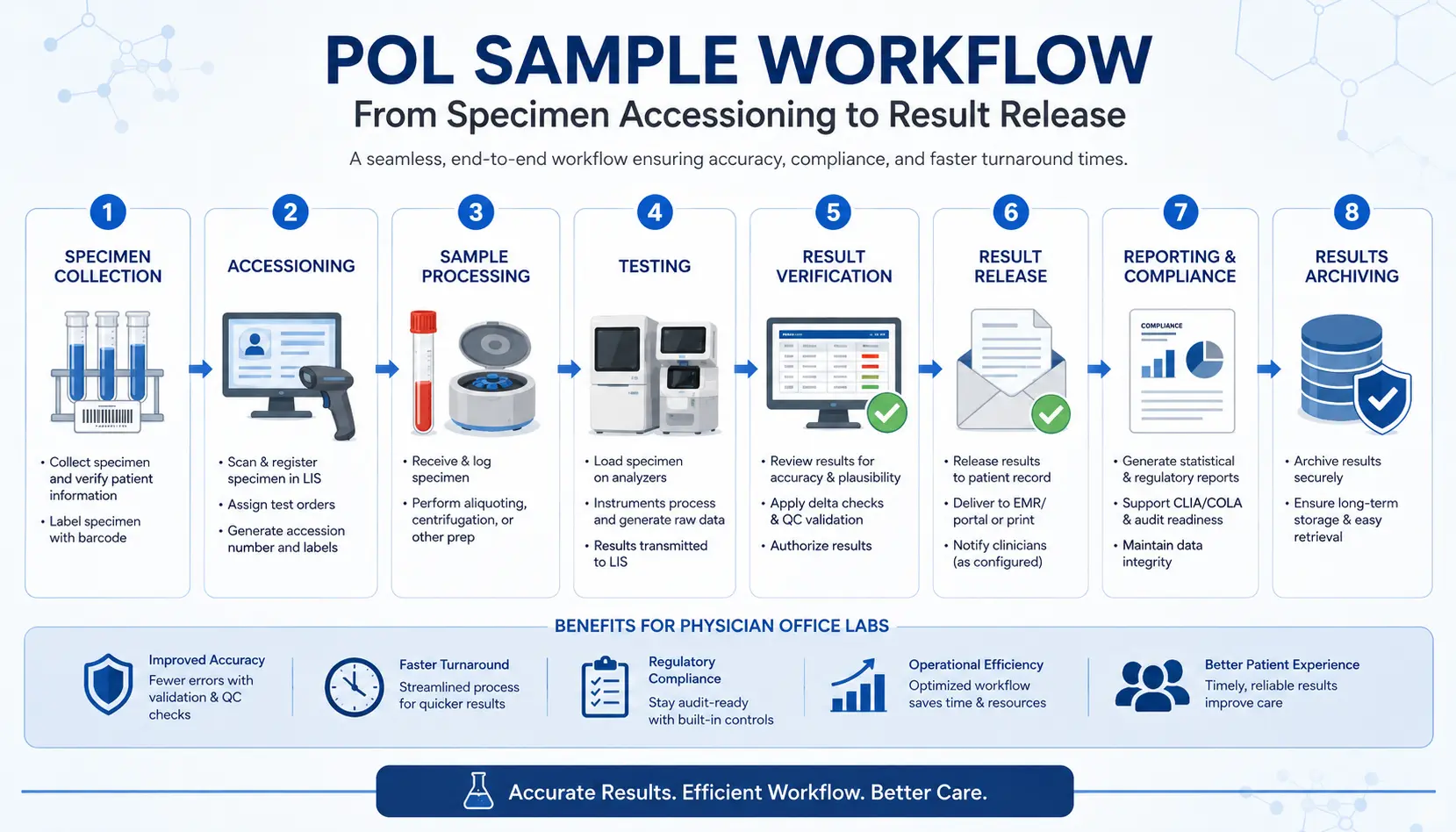
A laboratory information system (LIS) is the software layer that manages everything that happens between specimen collection and result delivery: patient and order intake, accessioning, instrument interfacing, quality control, result verification, reporting, and billing data. In a hospital or reference lab, an LIS has long been standard equipment. In a physician office lab, it’s now becoming the same because the operational load a POL carries today looks a lot more like a small reference lab than a simple point-of-care station.
The Physician Office Lab Market Is Growing and Getting More Complex
The numbers explain part of the urgency. Industry research firms tracking the office-based diagnostics segment report that the physician office laboratory testing market is on a mid-single-digit-to-double-digit annual growth trajectory through the mid-2030s, fueled by practices adding in-house hematology, chemistry, and molecular testing rather than referring every specimen out. Growth is concentrated in specialty practices cardiology, endocrinology, women’s health, and pain management that want same-visit results to support faster clinical decisions.
At the same time, Medicare’s Clinical Laboratory Fee Schedule continues to tighten. CMS requires applicable laboratories including many physician office labs to report private payor rate data under PAMA, and reimbursement pressure has made clean, well-documented claims essential to protecting margin. Growth in testing volume combined with shrinking reimbursement tolerance for errors is exactly the environment where manual, paper-based lab management starts to break down.
5 Reasons POLs Are Increasing LIS Investment
1. Test Volume and Complexity Have Outgrown Manual Tracking
Many POLs no longer run a handful of waived tests a day. They’re processing batches across chemistry, hematology, toxicology, and infectious disease panels sometimes on multiple analyzers at once. Once a lab crosses a certain volume threshold, spreadsheets, paper logs, and sticky-note tracking stop scaling. An LIS centralizes:
- Specimen accessioning and unique ID assignment
- Workflow routing between stations and analyzers
- Quality control (QC) validation before results are released
- Result verification and delta checks
- Turnaround time (TAT) monitoring by test and by ordering provider
This is where automation pays off immediately: fewer transcription errors, fewer lost specimens, and a visible queue that shows exactly where every sample sits in the process.
2. Payers Are Demanding Structured, Defensible Documentation
Clean claims now depend on more than an accurate test result. Payers expect an unbroken, auditable trail between the order, the medical necessity, the result, and the bill. That trail includes:
- Correct CPT and ICD-10 coding tied to the actual test performed
- Documented medical necessity for each ordered test
- A traceable link between the physician’s order, the result, and the billed code
- Time-stamped audit logs that hold up under payer or regulator review
A modern LIS builds this documentation automatically as part of the testing workflow, instead of requiring staff to reconstruct it after the fact which is typically where denials originate.
3. CLIA and COLA Compliance Pressure Has Intensified
Labs certified under CLIA or accredited by an organization such as COLA are expected to maintain ongoing quality control logs, proficiency testing records, personnel competency documentation, and specimen chain-of-custody records at all times, not just before an inspection. When these records live in binders, shared drives, or someone’s memory, gaps are almost guaranteed. An LIS enforces compliance as a byproduct of daily use: QC has to be logged before a result can be released, proficiency testing schedules trigger reminders, and every record is timestamped and exportable for inspection.
4. Staffing Is Tight, and Automation Fills the Gap
Most physician office labs run with one or two testing staff, often wearing multiple hats across the practice. A well-configured LIS replaces repetitive manual tasks with automated logic:
- Autoverification rules that release normal, in-range results without manual sign-off
- Reagent and lot-tracking to prevent stockouts or expired-reagent errors
- Automatic report generation and delivery
- Direct result delivery into the EHR/EMR via an HL7 interface instead of manual re-entry
The practical effect is that a lean team can safely handle a volume of testing that would otherwise require additional headcount.
4a. Interoperability Has Become a Baseline Expectation, Not a Bonus
Practices increasingly expect lab results to flow directly into the patient’s chart the moment they’re finalized no faxing, no re-keying, no PDF attachments. This depends on the LIS supporting standard health data exchange protocols (HL7 and increasingly FHIR) so it can talk cleanly to EHR platforms, reference lab interfaces, and analyzer instruments without custom, fragile point-to-point workarounds.
5. Patients Expect Speed and Digital Transparency
Patients accustomed to real-time updates from retail pharmacies and consumer health apps now expect the same from their physician’s lab. An LIS supports:
- Faster, more consistent result turnaround
- Secure patient portal access to results
- Automated notifications when results are ready
- Clean, standardized report formatting for both patients and referring providers
This isn’t just a convenience feature it directly affects patient satisfaction scores and physician confidence in the lab’s reliability.
Manual Lab Management vs. LIS-Enabled Physician Office Lab
| Function | Manual / Paper-Based POL | LIS-Enabled POL |
|---|---|---|
| Specimen tracking | Paper logs, whiteboards, sticky notes | Electronic accessioning with unique specimen IDs |
| Result delivery | Fax, phone call, manual chart entry | Automated HL7 delivery into the EHR |
| Billing accuracy | Manual CPT/ICD-10 entry, prone to mismatches | Structured, order-linked coding with audit trail |
| Compliance documentation | Reconstructed before inspections | Continuously logged, export-ready at any time |
| Staff capacity needed | Scales with volume | Automation absorbs volume growth |
| Patient result access | Phone calls, mailed reports | Real-time portal and notifications |
What to Look For When Choosing an LIS for a Physician Office Lab
Not every LIS is built with a small, in-office lab in mind many platforms are designed for large reference labs and carry cost and complexity that a POL doesn’t need. When evaluating options, prioritize:
Core Capabilities
- Bidirectional instrument interfacing so results flow automatically from analyzers into the LIS without manual entry
- EHR/EMR connectivity via HL7 or FHIR to eliminate duplicate charting
- Built-in billing and RCM tools, or clean integration with your existing billing system, to reduce denials
- Configurable QC and compliance workflows mapped to CLIA and, if applicable, COLA requirements
- Patient and referring-provider portals for self-service result access
Practical Fit for a Small Lab
- Fast onboarding without months-long implementation timelines
- Cloud-based deployment that doesn’t require dedicated IT infrastructure
- Pricing that scales with test volume rather than requiring enterprise-level commitments
- A support team that understands ambulatory and physician office lab workflows specifically, not just hospital labs
How to Roll Out an LIS Without Disrupting Daily Testing
Step 1: Map Your Current Workflow
Document every step from order intake to result delivery, including where errors or delays currently occur most often. This becomes the blueprint the LIS configuration should match.
Step 2: Confirm Interface Requirements
List every analyzer, EHR system, and billing platform that needs to connect to the new LIS, and confirm interface compatibility before committing to a vendor.
Step 3: Run a Parallel Testing Period
Most labs run the new LIS alongside existing processes for a short window to validate accuration before fully retiring manual backups.
Step 4: Train Staff on Compliance-Critical Steps First
Prioritize training on QC entry, result verification, and audit logging the steps most tied to CLIA/COLA compliance before moving to secondary features.
Step 5: Audit Results After 60–90 Days
Compare turnaround time, denial rates, and staff time spent on manual tasks before and after go-live to quantify the return on investment.
The ROI Case: What Labs Typically Gain
While results vary by lab size, test mix, and prior workflow maturity, labs that move from manual processes to an LIS commonly report measurable gains in three areas:
- Turnaround time — automated routing and autoverification shorten the time between specimen collection and result release
- Billing accuracy — structured, order-linked documentation reduces avoidable denials tied to coding mismatches or missing medical necessity documentation
- Staff productivity — existing staff can absorb higher testing volume without proportional headcount increases, since repetitive manual steps are automated
Because these gains typically don’t require new equipment or additional hires, the payback period for a well-implemented LIS is often measured in months, not years.
Common Content Gaps: What Most POLs Overlook Before Buying an LIS
Data Ownership and Portability
Confirm who owns your data and how easily it can be exported if you switch vendors later. Locked-in, proprietary data formats can make future migrations costly.
Cybersecurity and HIPAA Safeguards
Because an LIS handles protected health information, confirm encryption standards, access controls, and audit logging meet HIPAA Security Rule expectations this is as important as any clinical feature.
Scalability Beyond Waived Testing
If your lab plans to expand into moderate-complexity or molecular testing, choose an LIS that can grow with that test menu rather than requiring a full platform switch later.
Final Thought: LIS Investment Is Now a Baseline Operational Decision
Physician office labs used to view LIS software as an upgrade reserved for larger operations. That assumption no longer holds. As testing volume rises, payer documentation requirements tighten, and CLIA/COLA compliance stays non-negotiable, an LIS has become the infrastructure that lets a small lab operate with the accuracy, speed, and audit-readiness of a much larger one without adding staff or replacing existing instruments.
For POLs still relying on manual workflows, the question is no longer whether to invest in an LIS, but how quickly the transition can happen before billing denials, compliance gaps, or turnaround delays start costing real revenue.
Ready to see what a purpose-built LIS looks like for your physician office lab? Request a live walkthrough to map your current workflow against a modern, compliance-ready Prolis LIS setup.